Peptide reconstitution · dose · insulin-syringe units
Peptide Dosage Calculator
Your vial & dose
Draw this
Reconstitution changes only the concentration, never the total peptide. More water → finer resolution on the syringe but a bigger injection volume; less water → a smaller volume but coarser steps. Try a couple of water volumes above to land your dose on a round number of units. See the full method in the reconstitution guide and the units & questions page.
How the calculation works (nothing hidden)
Four short steps take you from a dry vial to a number of units on the barrel:
| Step | Formula | Worked example |
|---|---|---|
| 1 · Concentration | peptide (mg) ÷ water (mL) | 5 ÷ 2 = 2.5 mg/mL |
| 2 · In micrograms | mg/mL × 1000 | 2.5 → 2500 mcg/mL |
| 3 · Draw volume | dose ÷ concentration | 250 ÷ 2500 = 0.10 mL |
| 4 · Units (U-100) | mL × 100 | 0.10 × 100 = 10 units |
On a U-100 insulin syringe one unit is 0.01 mL, so the millilitre volume simply multiplies by 100 to become units. A U-40 barrel puts 40 units in a millilitre, so it multiplies by 40 instead — the calculator switches the factor for you.

Why this one is different
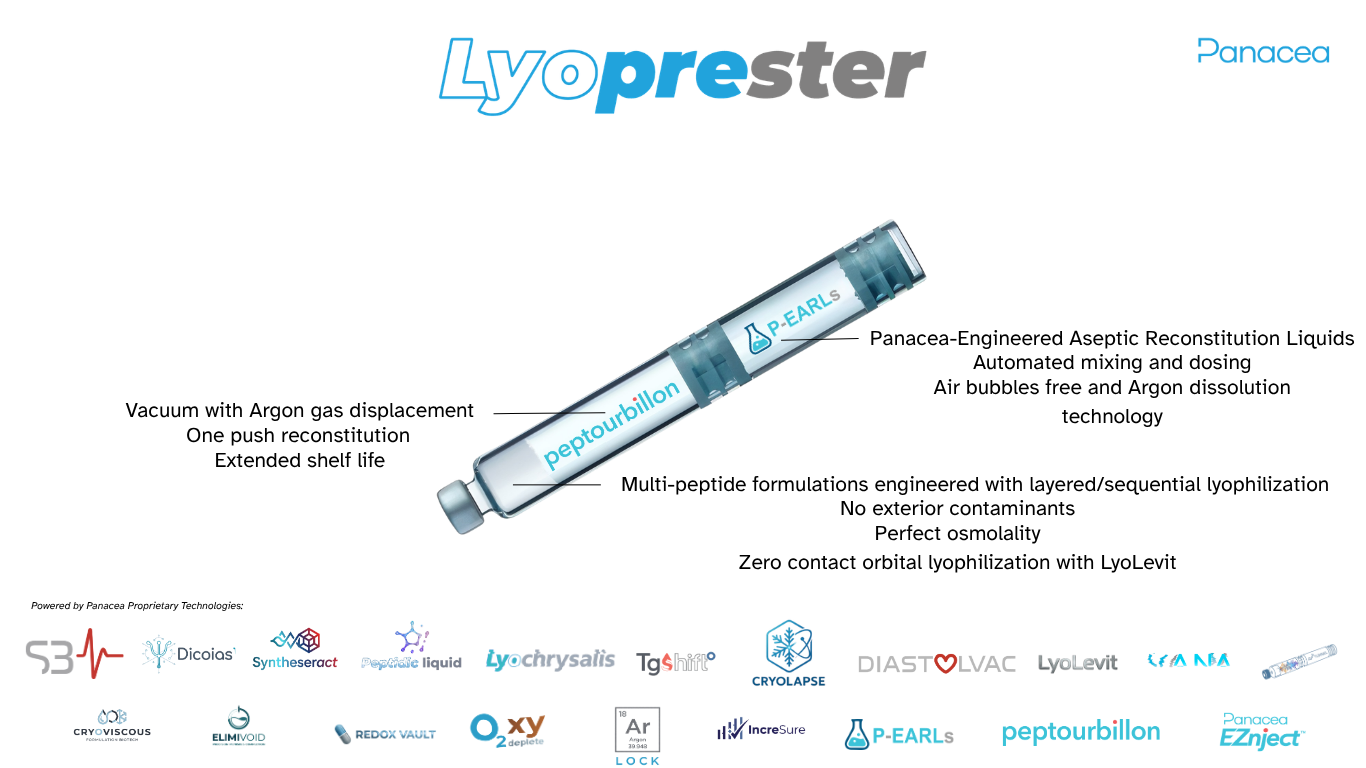
Most peptide calculators stop at a single number. This tool shows the whole chain — concentration, volume, units, mcg-per-unit and doses-per-vial together — and draws the syringe so the number has a physical meaning. It is built by Panacea Bio Chem, whose reconstitution and drying work runs through the Lyoprester® and Peptourbillon™ systems, with dosing delivered through EZnject™. The exact formulation and hardware parameters behind those are a proprietary Panacea Bio Chem secret.
Frequently asked questions
How do I get from a dose in mcg to units on the syringe?
What is “mcg per unit”?
How much bacteriostatic water should I use?
Does more water mean a weaker dose?
What this calculator does not know
The arithmetic above is exact for the numbers you enter. What no calculator in this category can see is the physical layer between the label and the barrel. Each limit below is a published mechanism — not a measured figure for any specific peptide — and none of it changes the maths; it tells you what the maths is built on.
- Labelled mass, not measured mass. The first input is the mass printed on the vial. Net peptide content (salt form, water, counter-ion) and any overfill sit outside what a label — or a calculator — can tell you.
- Dead space. A syringe retains fluid in the hub and needle after the plunger stops, so a drawn volume and a delivered volume are not the same number. Dead space and injector design measurably change the delivered drug amount in the injection-device literature (Havuz et al., 2021, PMID 33242996 — intravitreal devices, cited as the mechanism, not as a peptide measurement).
- Adsorption. Small molecules can adsorb to plastic surfaces — documented for syringe filters (Li et al., 2019, PMID 30529169, in vitro) and for a tracer adhering to plastic syringes (Reynolds & Kikut, 2016, PMID 26306938). Whether a given peptide adsorbs to a given barrel is unmeasured — a real mechanism, not a figure you can subtract.
- Complete dissolution. The maths assumes the whole cake dissolves. Reconstitution completeness is a measurable, non-trivial property (Partridge et al., 2019, PMID 30903389) — one more reason the vial’s contents are taken on trust by every calculator, this one included.
The documented ways this arithmetic goes wrong
These failure modes are published, and they sit on exactly the steps this site performs — which is why the method above is printed in full rather than hidden. Descriptive only:
- Ten-fold slips. Two patients self-administered 10-fold dosing errors with compounded semaglutide drawn from a vial; one reported dosing “in milliliters and units rather than in milligrams” — the unit-system collision this calculator exists to remove (Lambson et al., 2023, PMID 37392810, case series).
- Wrong volume and air, even in trained hands. Of 1,100 insulin syringes prepared by 22 nurses, 1.0% held the wrong volume and 6.5% contained air meeting an inaccuracy definition (Cabri et al., 2021, PMID 32755240 — hospital nurses preparing insulin: a preparation-error measurement, not a peptide study).
- Decimal-point slips are not compound-specific. A published diazoxide overdose turned on a decimal point (Meleis et al., 2024, PMID 38989349) — the same arithmetic failure in a different drug class entirely.
- Concentration-system confusion scales up. Concentrated U-500 insulin warranted dedicated electronic-health-record controls in hospital practice (Willner et al., 2022, PMID 34746953) — the institutional version of the U-100/U-40 toggle above.
- Calculation aids help — elsewhere, so far. A smartphone dose-calculation app was associated with lower anaesthesia-related mortality than standard calculation in 939 mice (Jara et al., 2021, PMID 34368269 — animal laboratory evidence, labelled as such). No human trial of a peptide reconstitution calculator was identified in PubMed as of 2026-09-08, and none is claimed here.
References
- Insulin syringe — units, U-100 and U-40 scales (Wikipedia)
- Reconstitution of medication (Wikipedia)
- Bacteriostatic water for injection (Wikipedia)
- Lambson et al., 2023 — administration errors of compounded semaglutide reported to a poison control center (case series) — Journal of the American Pharmacists Association
- Cabri et al., 2021 — computer-vision measurement of insulin syringe preparation errors (n=1,100) — Journal of Diabetes Science and Technology
- Havuz et al., 2021 — dead space and injector design change the delivered dose — European Journal of Ophthalmology
- Li et al., 2019 — hydrophobic drug adsorption loss to syringe filters — Journal of Pharmacological and Toxicological Methods
- Reynolds & Kikut, 2016 — tracer adherence to plastic syringes complicates dose reduction — Journal of Nuclear Cardiology
- Partridge et al., 2019 — magnetic resonance assessment of lyophilised drug reconstitution — Pharmaceutical Research
- Meleis et al., 2024 — a decimal-point overdose case (diazoxide) — Cureus
- Willner et al., 2022 — electronic-health-record controls for concentrated U-500 insulin — American Journal of Health-System Pharmacy
- Jara et al., 2021 — a dose-calculation app vs standard calculation in mouse anaesthesia — Frontiers in Veterinary Science